Partner Margarethe Müller
Queer Places:
Wellesley College (Seven Sisters), 106 Central St, Wellesley, MA 02481
Woodlawn Cemetery, 148 Brook St, Wellesley, MA 02482, United States
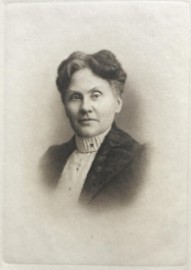 Carla Wenckebach (February 14, 1853 - December 29, 1902) was a pioneering educator, scholar, and head of the German department at Wellesley College during the late
nineteenth century. Known for her commanding presence, academic rigor, and non-conformist lifestyle, Wenckebach is frequently studied in the context of nineteenth-century
women's education, gender non-conformity, and early academic romantic networks.
Carla Wenckebach (February 14, 1853 - December 29, 1902) was a pioneering educator, scholar, and head of the German department at Wellesley College during the late
nineteenth century. Known for her commanding presence, academic rigor, and non-conformist lifestyle, Wenckebach is frequently studied in the context of nineteenth-century
women's education, gender non-conformity, and early academic romantic networks.
Born in Hildesheim, Germany, Wenckebach exhibited a strong aversion to traditional female socialization from an early age. She strongly resisted domestic expectations such as sewing
and knitting, viewing them with disdain, and actively sought out the company of boys.
Preferring male companions and active pastimes, she engaged in tree climbing, marble games, eel-catching, smoking, and whistling.
For as long as her parents permitted, she discarded dresses in favor of a masculine "Russian blouse and bloomers."
In her youth, she rejected her given feminine Christian names, insisting instead on being called Cato—after the Roman statesman and writer. A school friend later remarked
that the name suited her authoritative carriage and a demeanor that "repudiated everything suggestive of feminine weakness or dependence."
Her early education was obtained at the Girls' High School in Hildesheim, Germany, her native city, and later she attended the Normal School at Hanover and Zurich and
Leipsic Universities. For several years she taught in England, Belgium, Russia, and New York.
Wenckebach eventually found her professional home in higher education in the United States. Since 1883, she served as a professor and chair of the German department
at Wellesley College, where she became a prominent and influential figure among faculty and students alike.
She was the author of several educational books on the German language, some of them conjointly with her sister, Helen W. Wenckebach. Together they also edited a number of
German literary works, including a collection of the best German songs. Among her works were editions of Meissner's "Aus Meiner Welt," “Die Meisterwerke des Mittelalsters,"
Scheffel's "Trompeter von Sakkingen," Schiller's "Marie Stuart," Dann's "Ein Kampf um Rom."
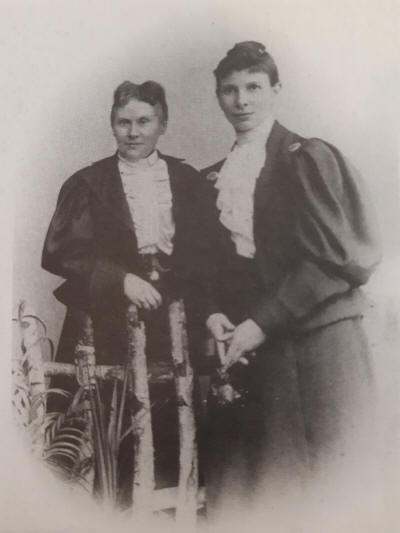
Carla Wenckebach and Margarethe Müller
Alongside her academic contributions, she cultivated a close
personal and professional partnership with her departmental colleague, Margarethe Müller.
Wenckebach’s life offers a notable window into nineteenth-century academic networks of women, gender inversion, and romantic friendships among female intellectuals:
As a student, she naturally drew an adoring circle of enthusiastic young women.
During her tenure at Wellesley, Wenckebach fell in love with Alice Freeman Palmer, the college's president. Freeman's
eventual marriage to George Herbert Palmer came as a devastating blow to Wenckebach, who viewed the union with profound grief, reportedly attending the wedding "as if to a
funeral."
In her later years, Wenckebach formed a lifelong domestic and professional dyad with Margarethe Müller. The two lived and worked closely together until Wenckebach’s
untimely death on December 29, 1902.
References:
Other References:
- Primary Biographical Source: Margarethe Müller, Carla Wenckebach, Pioneer (Boston: Ginn & Co., 1908).
- Academic and Professional Context: Publications and departmental records from Wellesley College (including co-authored works by Carla Wenckebach and Margarethe Müller, such as editions of Schiller's Maria Stuart, 1900).
- Historical Framework on Nineteenth-Century Women's Networks: Scholarship surrounding academic partnerships, female reformers, and romantic friendships in higher education during the late 19th and early 20th centuries.
Support this project
This website is a passion project researched, developed, and funded entirely by me. If you find the content valuable and would like to help support the ongoing research and hosting costs, any contribution is deeply appreciated.
Thank you for keeping this independent resource alive!
My books on Amazon: Elisa Rolle's books
BACK TO HOME PAGE

